
Best Protein Breakfast Ranked: 12 USDA Entries per 100 g
Best protein breakfast by the numbers: protein per 100 g and per portion for 12 USDA entries, plus four recipes from our own recipe pages read against them.
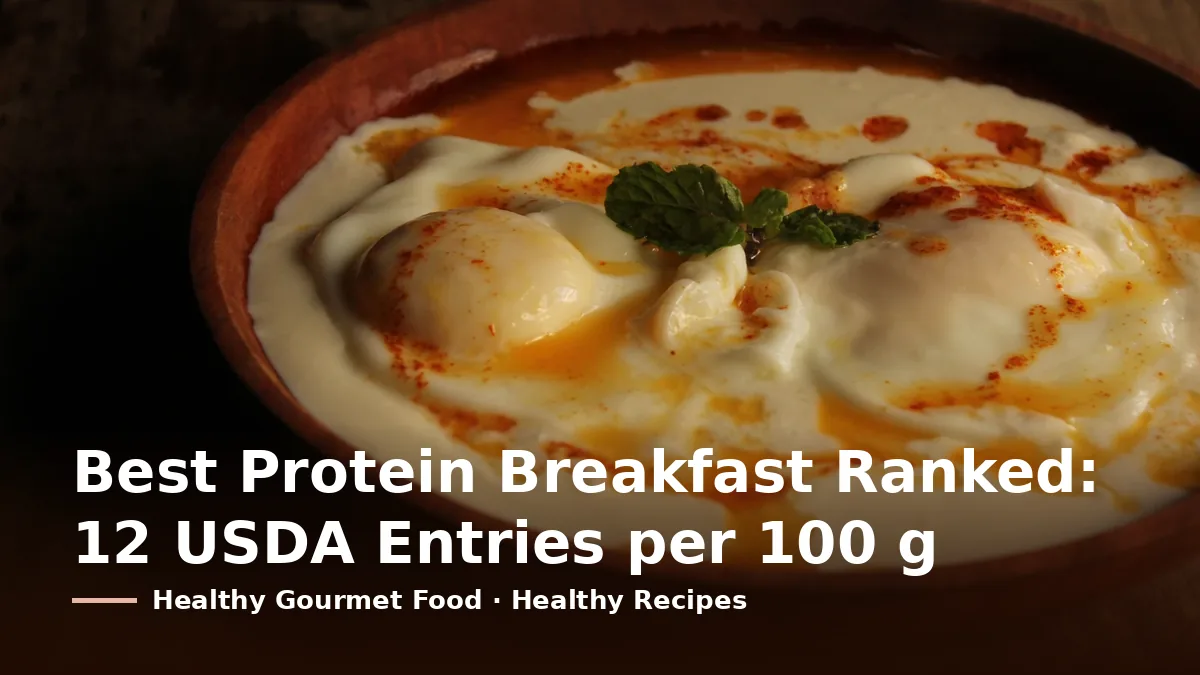
“Best” is a ranking word, and a ranking needs a number. The number here is grams of protein per 100 g from the USDA’s SR Legacy database, with USDA’s own portion weights alongside so you can see what a spoonful, a slice or a container actually delivers. Then four recipes already on this site are read against those figures, including one that is deliberately the low-protein comparison.
The quick answer
| Food | USDA entry | Protein per 100 g | USDA portion | Protein per portion (ours) |
|---|---|---|---|---|
| Peanut butter | smooth style, without salt | 22.21 g | 2 tbsp, 32 g | 7.1 g |
| Almonds | nuts, almonds | 21.15 g | 1 oz, 28.35 g | 6.0 g |
| Shrimp | crustaceans, shrimp, raw | 20.1 g | 3 oz, 85 g | 17.1 g |
| Chia seeds | dried | 16.54 g | 1 oz, 28.35 g | 4.7 g |
| Feta | cheese, feta | 14.21 g | 1 oz, 28.35 g | 4.0 g |
| Oats, dry | regular and quick, not fortified | 13.15 g | 1/3 cup, 27 g | 3.6 g |
| Egg | whole, raw, fresh | 12.56 g | 1 large, 50 g | 6.3 g |
| Whole wheat bread | commercially prepared | 12.45 g | 1 slice, 32 g | 4.0 g |
| Cottage cheese | lowfat, 2% milkfat | 10.45 g | 1 cup, 226 g | 23.6 g |
| Greek yogurt | plain, nonfat | 10.19 g | 1 container, 170 g | 17.3 g |
| Yogurt | plain, whole milk | 3.47 g | 1 cup, 245 g | 8.5 g |
| Oats, cooked with water | regular and quick, unenriched | 2.54 g | 1 cup, 234 g | 5.9 g |
The per-100 g column and the per-portion column disagree, and that disagreement is the whole point. Nuts and seeds top the first column and sit near the bottom of the second because nobody eats 100 g of chia. Cottage cheese and Greek yogurt are mid-table per gram and first and second per portion because the portion is large. The dry and cooked oats rows are the same food; the gap is water.
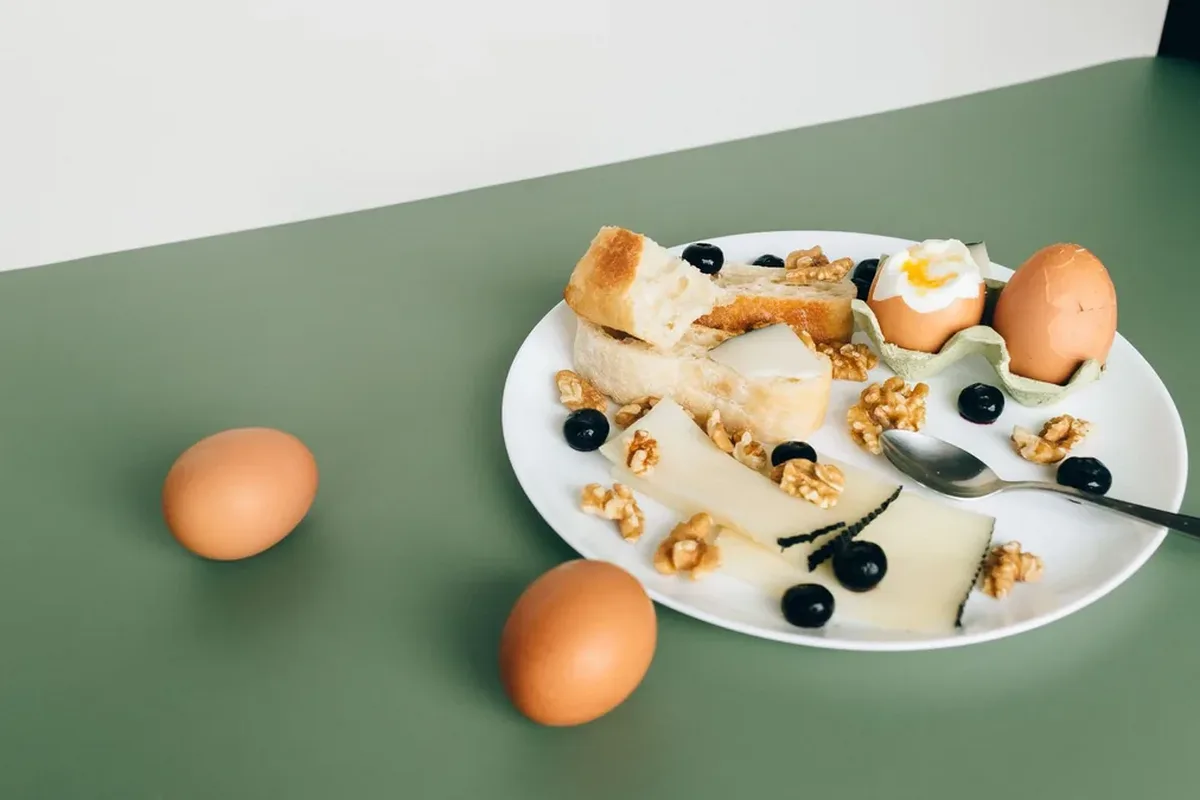
How to read the table
Three things about the source, before the recipes. SR Legacy is the USDA’s standard reference release from April 2018, still served by FoodData Central. Values for egg and shrimp are raw, so a cooked weight will read higher per 100 g because water has cooked off. And the portion weights are USDA’s, from the same entries, but the multiplication in the last column is ours, rounded to one decimal.
One more line that is not in the table: the NHS eight tips for healthy eating page puts breakfast last and says “a healthy breakfast high in fibre and low in fat, sugar and salt can form part of a balanced diet”. Its example is “a wholegrain lower sugar cereal with semi-skimmed milk and fruit sliced over the top”. That is a fibre-first breakfast, not a protein-first one, and the two are not in conflict: the oats row above is where the fibre comes from, and the rows above it are what you add.
Recipe 1: baked eggs with tomato and feta
The baked eggs with tomato and feta on this site is 8 eggs cracked into wells in 2 cups of roasted cherry tomatoes with 4 oz of crumbled feta, baked “3–5 minutes” at 450°F after the tomatoes have had 8 minutes, and served with 4 cups of dressed greens and toast. The page does not print servings. Split it four ways – our assumption, not the page’s – and each share is two eggs, about 12.6 g, plus a quarter of the feta. The 4 oz of feta is 113 g, about 16.1 g of protein for the whole dish, so roughly 4 g a share, before the bread. All of that arithmetic is ours; the quantities are the page’s.
Recipe 2: mushroom and shrimp frittata
The Italian-style mushroom and shrimp frittata is 4 eggs, 50 g mushrooms, 200 g shrimp, an onion and scallions, cooked in one covered skillet: mushrooms 3 minutes, shrimp 1 more minute, eggs 2 minutes “until set”. The page prints “4 eggs” without a size; at USDA’s large-egg weight of 50 g that is about 25 g of protein, and 200 g of raw shrimp about 40 g, so the whole frittata is around 65 g and half of it about 33 g – ours, on the USDA figures. The page does not say how many it serves, so there is no per-serving number to give. Here the second protein food outweighs the eggs: about 40 g from the 200 g of shrimp against about 25 g from the four eggs, where the baked eggs above run the other way, about 50 g from the eggs against about 16 g from the feta. Its timed steps add up to 6 minutes, the shortest of the three pages here that print times, with its onion and mushroom steps untimed.
Recipe 3: the meal prep page, for the rest of the week
The high protein breakfast meal prep ideas page is not a single recipe but seven formats: egg bites whisked “with cottage cheese or Greek yogurt”, Greek yogurt parfait jars with “berries, chia seeds, chopped nuts, and a spoonful of oats or low-sugar granola”, savory breakfast bowls, overnight oats with Greek yogurt and “chia or hemp seeds” stirred in, cottage cheese bowls, freezer breakfast burritos, and protein pancakes. Read against the table, three of the seven – the parfait jars, the overnight oats and the sweet cottage cheese bowls – pair a large-portion dairy row with a small-portion seed or nut row. The egg bites, the savory bowls, the burritos and the protein pancakes build on eggs instead, with the page offering turkey in the bites and black beans in the bowls and burritos as extras. Either way the numbers point one direction: the dairy or the egg carries the protein, the chia and nuts are toppings.
Recipe 4: double apple baked oatmeal, the comparison
The double apple baked oatmeal is included because it prints its own nutrition line: “Protein: 6 g” per serving, alongside “Fiber: 4 g” and “Sugar: 13.5 g (4.5 g added sugar)”. Those are the page’s figures, not USDA’s. The recipe is 3 cups of rolled oats, 2 eggs, 2 cups of milk, 1 1/2 cups of applesauce and 1/2 cup of maple syrup across a 9x13-inch dish, plus 1/2 cup of pecans, and the page does not break its 6 g down across the oats, eggs, milk and pecans. The NHS line asks for a breakfast “high in fibre and low in fat, sugar and salt”; this one prints 4 g of fibre but also 13.5 g of sugar and 15.5 g of fat a serving, so it meets the fibre half and not the rest. It freezes, and it is not the best protein breakfast – its own nutrition line says 6 g.
Putting it together
If the goal is the most protein for the least effort, the table and the four pages point the same way. Start from cottage cheese, Greek yogurt or eggs. Cottage cheese at 23.6 g a cup and Greek yogurt at 17.3 g a container are the two biggest per-portion rows, and eggs get there at three per serving; shrimp is the other row above 17 g, but few people cook it at breakfast. Add nuts, seeds or nut butter for texture and fat, knowing a portion adds 4 to 7 g, not 20. Use oats for fibre and accept that they bring little protein once cooked. And if you want one dish rather than a jar, the frittata is the one whose ingredient list does the work.
Before you rely on any of this
- SR Legacy is a 2018 release. We used its April 2018 entries because they carry portion weights for all twelve rows; the entry numbers are in the sources line.
- Raw values. Egg and shrimp are raw entries; cooked weights read higher per 100 g.
- Per-portion numbers are ours. They are USDA per-100 g values multiplied by USDA portion weights, rounded to one decimal.
- The recipe figures are the site’s own. The oatmeal’s “6 g” is the page’s line, not a USDA calculation, and the frittata and baked eggs pages do not state servings.
- Protein needs are individual. They vary by body size, activity, age and health status, as the meal prep page linked above also says; this article ranks foods, it does not set a target for you.
Sources
USDA FoodData Central, SR Legacy (April 2018 release), entries 172470, 170567, 175179, 170554, 173420, 173904, 171287, 172688, 172182, 170894, 171284, 173905. NHS, “8 tips for healthy eating” (page last reviewed 22 November 2022). Recipe quantities from the four healthygourmetfood.com pages linked above. All read 21 September 2026.
Frequently asked questions
What breakfast food has the most protein per portion?
Using USDA SR Legacy values and USDA's own portion weights, a cup of 2% cottage cheese (226 g) is about 23.6 g of protein and a 170 g container of nonfat Greek yogurt about 17.3 g. Per 100 g, peanut butter and almonds rank higher, but their portions are 32 g and 28 g, so they land at about 7 g and 6 g. The multiplication is ours.
How much protein is in one egg?
USDA SR Legacy lists whole raw egg at 12.56 g of protein per 100 g and a large egg at 50 g, so one large egg is about 6.3 g by our arithmetic. Two eggs are about 12.6 g, and the four-egg frittata on this site is about 25 g from the eggs alone before the 200 g of shrimp.
Are oats a high protein breakfast?
Dry oats are 13.15 g of protein per 100 g in USDA SR Legacy, but cooked with water they are 2.54 g per 100 g because most of the weight is water. A 1/3 cup dry portion (27 g) is about 3.6 g. Oats carry the fibre the NHS breakfast tip asks for; the protein has to come from what you add.
- #high protein breakfast
- #USDA
- #eggs
- #cottage cheese
- #Greek yogurt